AI Agents vs. Chatbots: The Difference is Action (Quite Literally)
AI agents don’t just chat—they act. Explore how AI agents outperform chatbots with reasoning, integrations, and end-to-end workflow automation.


TL; DR
Chatbots are reactive; they follow scripts, rules, and basic NLP. Great for simple, structured conversations.
AI agents are a whole another species. They’re autonomous, goal-driven, powered by LLMs, and built to do things—not just talk. They can reason, make decisions, and carry out complex, multi-step workflows across your tools, APIs, and business systems.
Why This Distinction Matters More Than Ever
With AI rapidly reshaping business operations, two terms are being thrown around interchangeably, as though they mean the same thing: chatbot & AI agent.
Honestly? They’re not the same. And understanding this difference has become strategically essential.
Chatbots excel at predictable conversations, whereas AI agents execute complex actions.
Confusing the two leads to misaligned investments, failed automation initiatives, and wasted operational budget. So the question then arises: are chatbots becoming obsolete? What’s the next move?
Chatbots vs. Agents: The core difference
At the simplest level:
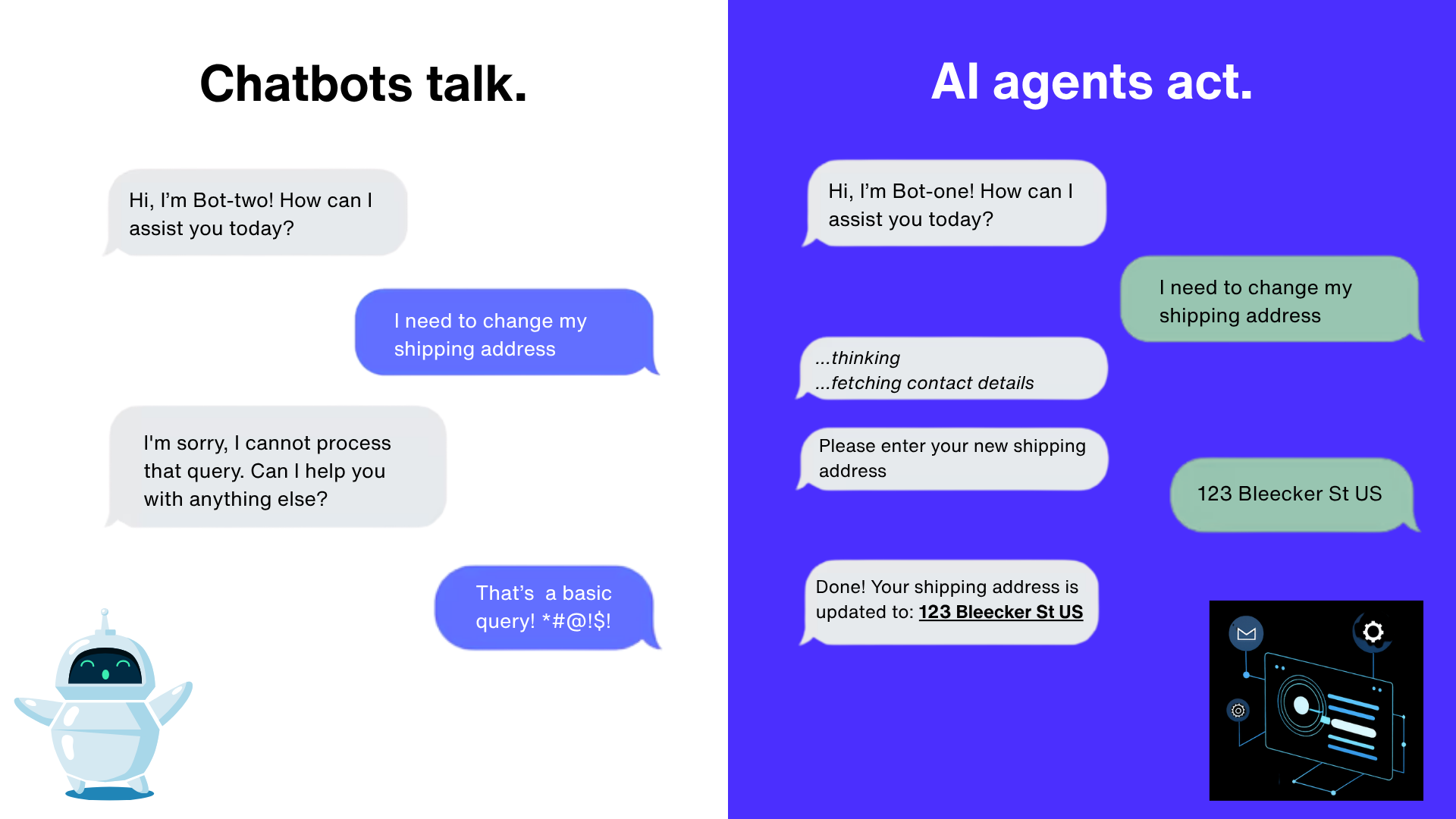
Chatbots talk. They provide scripted answers, guide users through predefined flows, and respond only when prompted.
AI agents act. They take initiative, make decisions, and execute multi-step workflows across systems to achieve real outcomes. Let’s look at the detailed differences between them.
Autonomy and Decision-Making
A chatbot can be thought of as a vending machine. You press the right buttons, and the right item pops up. However, an AI agent is like an expert cook. You just ask what dish you’d like to eat, and the agent whips it up in the kitchen.
Feature | Chatbots | Agents |
Autonomy | Reactive | Proactive & autonomous |
Decision-making | Scripted | Goal-driven, multi-step reasoning |
Actions | Limited & predefined | Execute actions across APIs, systems, tools |
Technology and Architecture
Traditional chatbots rely on rule-based engines, decision trees, keyword matching, and basic NLP. They cannot deviate from their scripts or reason beyond their predefined domain.
AI agents, on the other hand, leverage LLMs, advanced NLP, reinforcement learning, and multi-step planning. They understand context, interpret intent, plan actions, and integrate deeply with CRMs & APIs to autonomously deliver outcomes.
Task complexity & Scope of knowledge
Since chatbots operate within a confined knowledge domain & rely on static data, they excel at:
FAQs
Simple troubleshooting
Password resets
Collecting basic info
Predictable, high-volume workflows
AI agents, on the other handle:
Complex, multi-step workflows
Ambiguous or open-ended requests
Decision-making and prioritization
Real-time data synthesis
Autonomous problem resolution
Learning, memory, and adaptation
Chatbots have static learning, i.e., any updates to the knowledge must be manually programmed. However, they offer compliance, predictability, and have zero hallucination risk.
Agents follow dynamic learning, i.e., they learn continuously, from:
Interactions
Feedback loops
Patterns in behavior
Organizational data
Agents have immense intelligence, but require guardrails.
Economic and Strategic Considerations
Chatbots win on:
Lower upfront cost
Lower maintenance
Predictability
High-volume scalability
Compliance & auditing
AI agents shine on:
Depth of automation
Human-quality problem solving
Reduced handoff to human support
Higher CSAT & resolution rates
Strategic, long-term ROI
Chatbots deliver on cost savings through deflection, whereas AI agents create value through autonomy and end-to-end workflow automation.
Are chatbots obsolete?
AI agents are the best choice when the work gets complex. They can:
Handle multi-step tasks
Reduce the need for human intervention
Personalize interactions in a meaningful way
Operate seamlessly across tools, systems, and workflows
This is the reason they have a great potential to consistently drive higher conversion rates and better resolutions—becoming the future of high-value automation across sales, CS, ops, IT, and even logistics.
Where does that leave chatbots?
Chatbots still have an important role to play. They’re inexpensive, predictable, and fast: a perfect combination to handle 80% of routine inquiries that don’t require deep reasoning. They’re not obsolete at all; they’re optimized for simplicity.
So, what’s the right solution for your business?
It’s not a question of choosing between a chatbot or an AI agent. The real power comes from using both—each where it makes the most sense.
Chatbots are essential for the simple, predictable interactions that make up most day-to-day volume. But when you move into complex, high-value workflows, AI agents are the ones that deliver real transformation.
At the end of the day, the difference comes down to conversation vs. action. And understanding that distinction is what will shape the most effective automation strategies in the decade ahead.
See how AI agents can transform your business operations, improve efficiency, and elevate customer experience.
Book a personalized demo to experience how intelligent agents can help your team move from conversation to action, effortlessly
'%3e%3cpath%20d='M11.5732%2031.7068L19.2977%2022.7433L11.5732%2011.5366H17.4664L22.6245%2018.942L29.0522%2011.5366H30.7788L23.4029%2020.0985L31.4127%2031.7086H25.4997L20.1231%2023.9069L13.3197%2031.7068H11.5732ZM16.6519%2012.8366H13.9536L26.354%2030.4462H28.9926L28.8265%2030.1576L16.6519%2012.8366Z'%20fill='%230C0C0C'/%3e%3c/g%3e%3cdefs%3e%3cclipPath%20id='clip0_505_14364'%3e%3crect%20width='19.7681'%20height='20.2432'%20fill='white'%20transform='translate(11.573%2011.5365)'/%3e%3c/clipPath%3e%3c/defs%3e%3c/svg%3e)

'%3e%3cpath%20d='M25.2175%2011.7557L26.9132%2011.911V15.0496C26.0135%2015.1444%2024.1746%2014.7452%2023.5821%2015.5947C23.4908%2015.726%2023.3291%2016.1592%2023.3291%2016.3091V19.002H26.7392L26.3346%2022.5281H23.3291V31.5952H19.707V22.5863L19.649%2022.5281H16.6628V19.002H19.707C19.7813%2017.4024%2019.4664%2015.7042%2020.1132%2014.1986C20.6748%2012.8902%2021.7857%2012.0974%2023.1666%2011.8435L23.7151%2011.7557H25.2183H25.2175Z'%20fill='%230C0C0C'/%3e%3c/g%3e%3cdefs%3e%3cclipPath%20id='clip0_505_14375'%3e%3crect%20width='10.2695'%20height='19.8027'%20fill='white'%20transform='translate(16.658%2011.7567)'/%3e%3c/clipPath%3e%3c/defs%3e%3c/svg%3e)
About the Author
Praveenkumar

SEO Specialist
Praveenkumar is an SEO specialist who drives organic growth through performance-focused strategies and search trend insights. He helps businesses boost visibility and connect with the right audience. Outside of SEO, he enjoys writing tech blogs and spending time outdoors.
Transform your customer support today
Deploy your AI Chatbot in 10 minutes.
- No credit card required
- Setup in minutes
- Cancel Anytime
