Build, deploy, and scale AI agents with predictable pricing, deeper automation, and enterprise-grade control.
Sign upDecagon is a capable AI agent platform valued for its generative capabilities and multi-agent orchestration. However, real users and comparative research highlight common constraints that drive businesses to explore alternatives
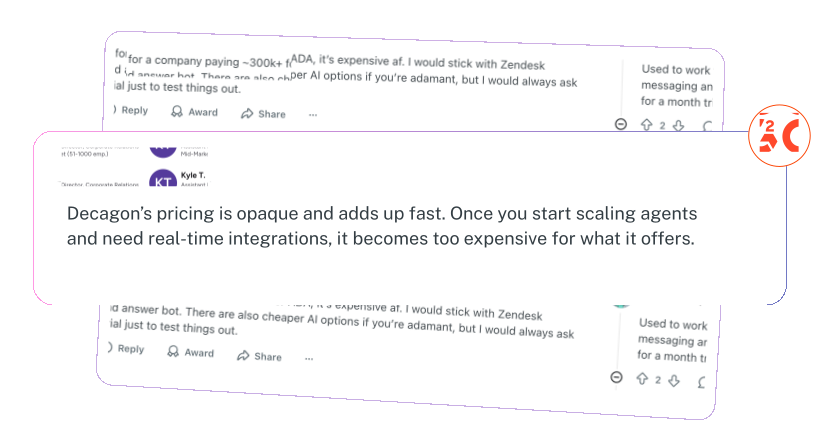
Unpredictable, usage-based pricing that becomes hard to forecast at scale
Limited analytics and optimization controls for understanding performance gaps
Strong Q&A engine, but weak on live context and real-action execution
pagergpt gives you the speed, control, and flexibility Decagon leaves out, faster resolutions, instant setup, transparent pricing, and enterprise-grade security in one powerful AI platform.
Opaque or volume-based pricing that spikes unpredictably as usage grows.
Steep onboarding and technical dependency, where non-technical teams struggle without engineering support.
Limited analytics and optimization controls for understanding performance gaps.
Rigid workflow customization, making complex automations harder to maintain or modify.
Partial or fragmented omnichannel support, requiring additional tools for full coverage.
For large teams that require predictable ROI, governance, deep integrations, and transparent pricing, these limitations often outweigh Decagon’s strengths especially when scaling support, sales automation, or internal ops across global markets
Transparent, scalable pricing with enterprise predictability
No-code agent building and workflow automation
Real-time integrations to CRM, helpdesk, commerce, and internal systems
Enterprise governance, security, and analytics dashboards
pagergpt.ai is a full-stack AI agent platform built to empower support, operations, and business automation teams
Unlike Decagon, which prioritizes agent orchestration and LLM compatibility, pagergpt.ai focuses on rapid deployment, measurable outcomes, and operational visibility so teams can launch strategic automation without technical bottlenecks.

Let’s compare why pagergpt is an excellent alternative to Decagon
| Capability | ||
|---|---|---|
| Pricing model | Volume-based / custom | Transparent tiered plans |
| Time to value | Weeks to configure | Hours to deploy |
| Customization | Developer-centric | No-code + visual workflows |
| Omnichannel support | Partial | Chat, WhatsApp, Slack, Teams, web |
| Analytics | Basic dashboards | Deep insights (CSAT, unresolved queries) |
| Human handoff | Requires integrations | Built-in shared inbox & routing |
| Action automation | Limited | Native CRM & business actions |
Grow support automation without unpredictable costs or heavy technical overhead.
Implement governed, audit-ready AI solutions that integrate with existing systems.
Leverage analytics, governance, and automation for cross-functional workflows beyond support.
Hear what our clients have to say about their experience with us.Real stories. Real results.
"pagergpt is truly a game-changer. As an AI Agent platform, it goes beyond simply providing answers, it actually performs tasks, making it an incredible valuable asset for our team."
It takes just four steps to go live, train, customize, integrate and deploy. No developers, no code, no waiting.

See how pagergpt delivers faster ROI, clearer pricing, and enterprise-ready AI agents. Sign up or talk to sales today.
Sign upExplore Decagon’s customer feedback, pricing details, and best alternative options.


Explore our frequently asked questions to learn more about pagergpt features, security, integration capabilities, and more
The best Decagon alternative for enterprises is pagergpt when you need predictable pricing, deeper analytics, no-code customization, and enterprise governance. pagergpt is designed for organizations that want scalable AI agents without usage-based cost surprises or heavy engineering dependency.
pagergpt focuses on predictable pricing, no-code agent building, deeper action automation, and enterprise-grade analytics. While Decagon emphasizes autonomous agents, pagergpt prioritizes operational clarity, ROI measurement, and business control, making it easier for CX, ops, and IT teams to manage AI agents at scale.
Yes. pagergpt is designed for mid-market and enterprise deployments, offering enterprise security, governance, audit logs, role-based access, omnichannel deployment, and scalable integrations. It supports organizations that require compliance, visibility, and long-term scalability.
Absolutely. pagergpt includes a no-code agent studio and workflow builder, allowing CX, operations, and business teams to configure, test, and improve AI agents without relying on engineering teams for every change.
Yes. pagergpt supports omnichannel AI agents across web chat, WhatsApp, Slack, Intercom, Zendesk, Microsoft Teams, and more, with a built-in shared live inbox for seamless human escalation something many teams find limited or fragmented in Decagon-based setups.
pagergpt includes a built-in shared live chat inbox that enables seamless escalation from AI to human agents. Teams can collaborate, route conversations, and resolve complex issues without relying on third-party tools.
Decagon typically uses usage-based or custom pricing, which can be difficult to forecast at scale. pagergpt offers transparent, tiered pricing, allowing finance and operations teams to plan budgets confidently without unexpected overages as AI usage grows.
pagergpt includes a built-in shared live chat inbox that enables seamless escalation from AI to human agents. Teams can collaborate, route conversations, and resolve complex issues without relying on third-party tools.
pagergpt provides advanced analytics including deflection rates, unresolved queries, sentiment analysis, agent performance, and handoff metrics. This level of visibility helps teams continuously improve AI outcomes an area where many Decagon users look for stronger capabilities.
pagergpt is ideal for organizations that want: Predictable AI automation costs Faster time to value Strong analytics and governance Omnichannel AI with human backup AI agents that go beyond customer support into operations, sales, HR, or IT